Science-guided Machine Learning
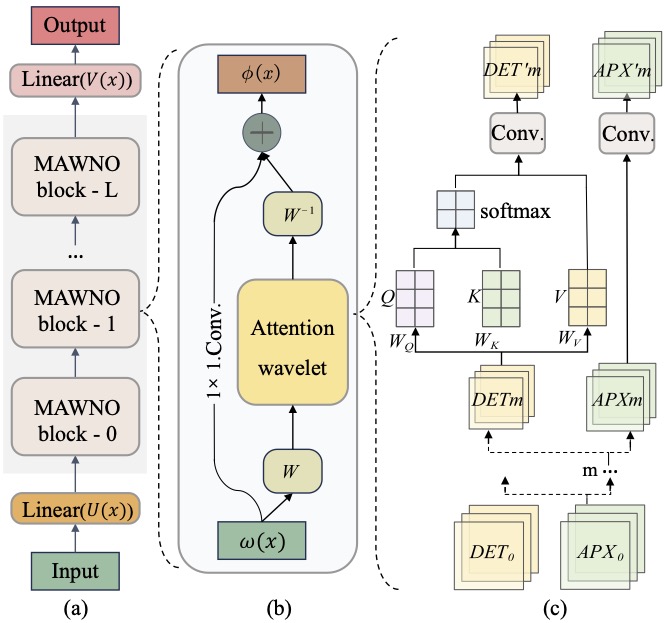
Science-guided machine learning provides a powerful way to model complex dynamical systems where traditional methods or purely data-driven ML often fall short. One key challenge is capturing sudden, sharp changes in behavior — for example, in cellular signaling pathways responding to environmental cues. To address this, we developed the Multiscale Attention Wavelet Neural Operator (MAWNO), which builds on physical and biochemical equations to establish input–output mappings without requiring large labeled datasets. By combining wavelet transforms with attention mechanisms, MAWNO captures both global rhythms and abrupt switches, offering a broadly applicable framework for studying diverse dynamical systems.
AI for Biological Oscillation Prediction
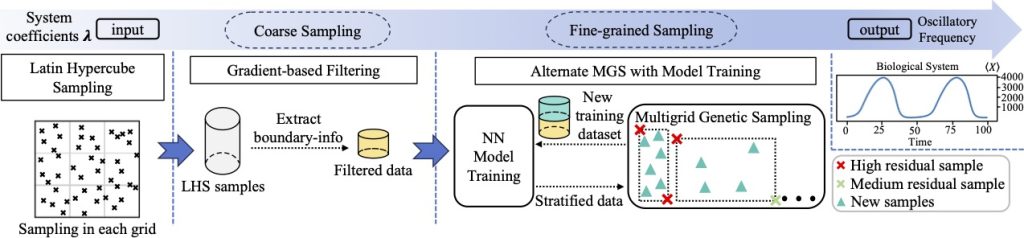
Biological oscillations—like rhythmic changes in cellular signaling—are essential for healthy function in living systems. We study how small variations in system parameters can drastically change these rhythms, making them challenging to predict. To tackle this, we develop advanced sampling strategies for machine learning that improve the accuracy of oscillation modeling. Our recent work introduced the Hierarchical Gradient-based Genetic Sampling framework, which enhances neural networks’ ability to capture complex oscillatory behaviors in biological systems.
Discovering Brain Network Dynamics
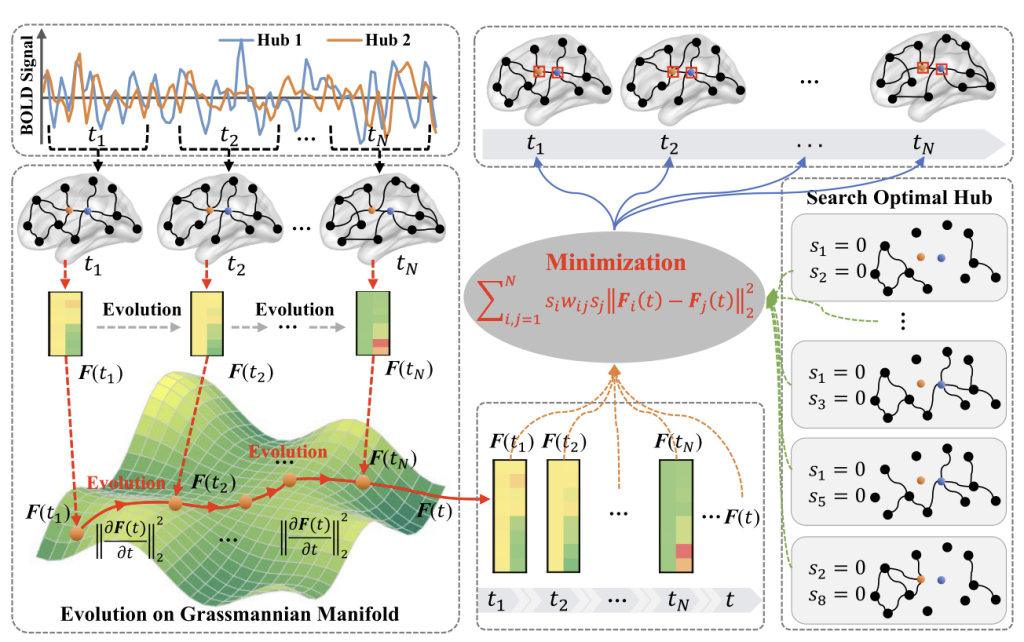
Brain networks are inherently dynamic — even at rest, their connectivity patterns shift over time. A small set of regions act as temporal hubs, flexibly adapting network connectivity in response to changing brain states. Identifying these hubs is key to understanding cognition and neurological disorders. We are interested in constructing neural mass models to understand brain structure and function, as well as high-level mental functions such as language, memory, and self-awareness, by way of functional magnetic resonance imaging (fMRI). Unlike traditional approaches that treat each time segment independently, we use a dynamic graph embedding framework that models time as a physical process and leverages Grassmannian manifold optimization. This allows us to preserve temporal consistency and better track the evolving topology of brain networks, leading to more reliable hub detection in both simulations and real data.
Multiscale Modeling for Alzheimer’s Disease
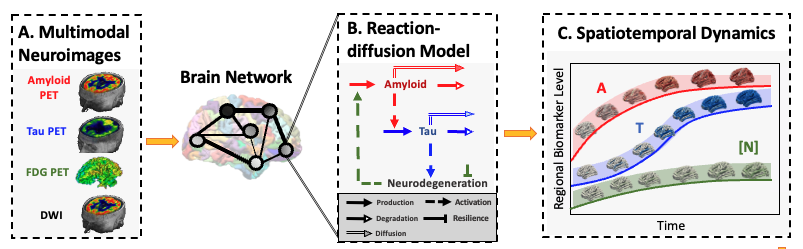
Alzheimer’s Disease (AD) is marked by complex, heterogeneous progression across patients, making it difficult to predict individual trajectories of cognitive decline. To address this challenge, we integrate multimodal neuroimaging, clinical, and genetic data into a network-guided multiscale modeling framework. This approach captures the spatiotemporal dynamics of AD biomarkers across brain networks, linking molecular changes to network-level dysfunction and cognitive outcomes. By combining biological knowledge with machine learning, our goal is to reveal how AD propagates through interconnected brain systems and why individuals experience such varied patterns of decline. This framework not only advances our understanding of disease mechanisms but also has the potential to improve early detection and guide personalized treatment strategies.
Bioinformatics for Cancer Drug with Single-Cell RNA-seq
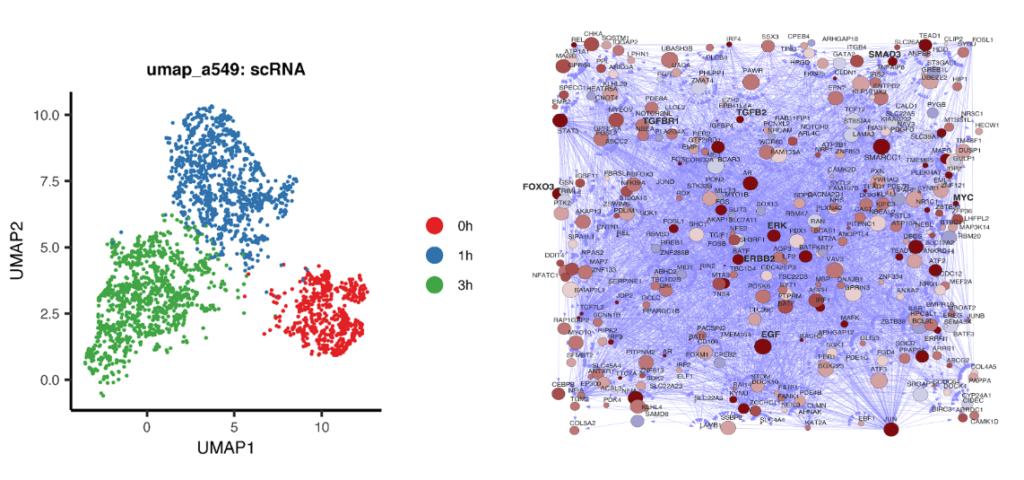
Lung cancer is the leading cause of cancer-related deaths worldwide. Dexamethasone (DEX), a commonly used drug, has shown promise in slowing the growth of lung cancer cells. To better understand how DEX works at the cellular level, we analyze a time-series single-cell RNA sequencing (scRNA-seq) dataset from lung cancer cells treated with DEX. Using bioinformatics, we aim to uncover the molecular mechanisms behind the drug’s effects, providing insights that could inform future therapies.
Grant
- NSF CAREER Award (PI), 10/2023–09/2028
- NIH R03 (Consortium PI), 08/2021–04/2024
- NSF Student Travel Grant (PI), 06/2023–05/2024
